~~PURA VIDA~~ My Costa Rican & Nicaraguan Adventure Tour
- Haylee Sandra
- Dec 22, 2016
- 19 min read
Updated: Dec 31, 2019
You all know I travel a lot. I like to see the world, experience new cultures and ways of life. I enjoy meeting new people, trying new food and stepping outside my comfort zone (to be honest, I don't know if I have a comfort zone anymore). With that, I can truly say that of all the places I've been, Costa Rica has risen to the top of the list. I'm not sure how to begin to a paint a picture of how incredible this country is, so just bare with me if I just repeatedly say it was the best experience ever.

DAY 1:
We arrived in Liberia, Costa Rica prior to noon on Monday. We were part of a tour group that had 8 days planned out for us. I highly recommend this when traveling to a foreign country, by the way, as it made everything SO much easier. All of our excursions were pre-planned and paid for, our transportation was included, plus we were being guided by knowledgeable tour guides who helped us learn so much about their country.
Our hotel for the first night was the Hilton Garden Inn by the Liberia airport, which we caught a shuttle to after we landed. The tour consisted of 20 people all together (plus 3 guides), but our group of friends alone took up 10 of those 20 spots (that's what happens when I plan vacations, I get so beside myself I start inviting everybody). I'm elated to say I made four new friends on this trip! Our tour truly consisted of some admirable people and I am grateful for having had each of them on this vacation.
Anyways, the first day we had a free-for-all as the tour didn't actually begin until Tuesday morning. So the ten of us made plans for the remainder of the afternoon/evening together. We started with mojitos by the pool, then later that night arranged for transportation into the city of Liberia (which was about 8 miles from our hotel). The taxi drivers are much more trusting in Costa Rica than they would ever be in America. The driver dropped all 10 of us off in Liberia and said he wouldn't collect payment until after he brought us home later. We told him to pick us back up at 10pm so that we would have time to eat dinner and experience whatever parts of the city we wished. Dinner and cheap drinks got the best of us though, since we stayed at a local restaurant the entire time. Again, they were much more trusting than any restaurant in America would be. We kept ordering drinks and food, then at the end were told to go to the cashier up front to let them know what we had all ordered so we could pay. That's very unguarded of people's honesty and integrity, especially for a group of 10 drunken Americans. Obviously, we are good people and would never take advantage of the situation. I just felt this was a very striking aspect of this country.
After we arrived back at our hotel, we pretty much passed out right away seeing as we had to be up at 5:30 the next morning to meet our tour for breakfast.
DAY 2:
5:30AM, up bright and early. We meet our tour guides and the other members in our group, sign all waivers in case we die, then enjoy a Costa Rican breakfast together before setting out on our day's activities. A typical Costa Rican breakfast consisted of sweet bunon or tostones, rice and beans, a spongy cheese, eggs and fresh fruit. And obviously a fresh cup of Costa Rican coffee. We had a 3 hour drive to make from Liberia, but the route was scenic and beautiful. Our tour guide explained to us how Costa Rica is made up of 7 provinces, 3 major ones outlying the country and the remaining four circle the capitol area of San Jose, where 4.8 million people reside. 25% of the country consists of protected areas and there are 129 national parks.

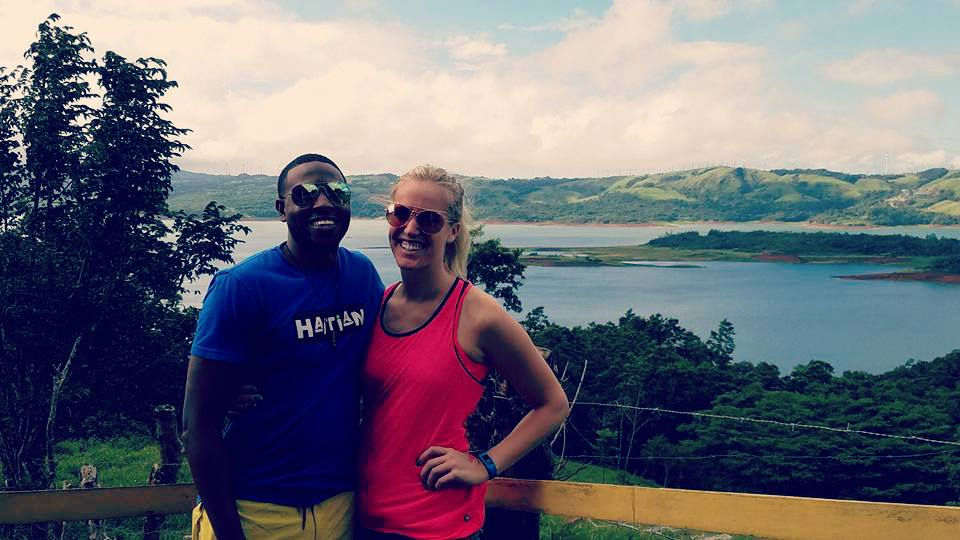
Our travels this day took us around Lake Arenal, which is the largest man made lake in Central America. The lake is 33 miles long and ranges up to 180 feet deep. It was created by filling a nearby valley with water from 1972-1976, and a city was actually moved in order to build it. We learned that when the water gets low enough, you can see a church steeple in the middle of the lake. In 1979, Lake Arenal was enlarged to three times its original size with the construction of a hydroelectric dam. The goal of this dam is to provide energy to not only the residents in the immediate vicinity, but to those throughout the rest of the country. Successful in these endeavors, the Lake Arenal Dam now produces nearly 12% of the country's total electricity. One of Costa Rica's most prominent goals is to become the first country in the world to use only natural energy and no fossil fuels. Implementing hydroelectric dams is a great start in this direction, coupled with the entire country being spotted with windmills and other sources for natural energy intake.

Lake Arenal: Central America's largest man-made lake.
Our guide explained to us how Costa Rica works well with Nicaragua. Over 400,000 Nicaraguan residents actually work in Costa Rica and send money back to their families since resources are more plentiful in CR and they typically make more money. Costa Rica is well known for their coffee beans and sugar canes. Since the sun is more perpendicular in this country due to its location close to the equator, a typical work day starts at 5AM, with lunch breaks happening around 9AM and the work day completing around noon.
We soon arrived in La Fortuna where we joined another group so we could set about our white water rafting excursion. I must admit I was not nearly as ready for this experience as I thought I was. I definitely underestimated the intensity that would come with the 2 hour trip down the river. My most closely related experience compares to rafting down the Little Wolf River in Wisconsin, which by no means constitutes as "white water rapids." Granted, we were only on level 3 rapids in CR (the levels go from 1: the easiest, to 5: the most intense), but it was still a risky ride. Luckily, our raft never flipped during the trip but a few others from our group went overboard. Our raft even had to execute a rescue mission by paddling upstream, grabbing wandering paddles and pulling some random guy up on our raft after he had been floating aimlessly over the rapids for a few minutes.
The Costa Rican who guided our white water rafting trip was a cool dude. He guided us down the river, instructed us when to paddle, when to duck and how to work together as a team. I was wearing a GoPro on my helmet, so this naturally made me the target for his daring suggestions. He took my paddle and encouraged me to shift my way to the front of our raft, allowing myself to go face first into the rapids. Needless to say, all it took was one large rapid that almost sent me face first over the front of the boat (the same rapid that flipped our friends' boat over completely) before I opted out of this fast.
Next, our tour guide took us off the beaten bath through a forestry area. He asked if we wanted to see some snakes, as he disappeared from our boat off into the jungle. He came back with his hands closed, exclaiming that he couldn't find any snakes but he found a few poisonous frogs. He then showed us these baby florescent red frogs that are considered poisonous because they can be lethal to other animals, but have hallucinogenic affects to humans. They only affect humans if they are eaten or if the frog comes in contact with an open wound. Mind you, our tour guide had an open wound on his hand (about an inch away from the poisonous frog) as he taught us this information. Pretty sure our guide liked to trip out on hallucinogenic frogs. Pura vida.
Half way through the trip, we stopped on shore where there was freshly cut pineapple and watermelon waiting for us, displayed on a few rafts set up shore-side. We learned that pineapple is actually not a fruit, but is technically a flower! The rest of the rafting trip was leisurely, as we scanned for birds and spotted a pretty chill sloth in the jungle (I am a huge sloth fan now, by the way). Upon return, we had lunch prepared for us by some locals who also taught us the art of making Costa Rican coffee. They do not use disposable coffee filters, but rather a dense bag that is reused 8-10 times before washed. Freshly ground beans are then placed in this bag over a mug, and hot water is poured directly into the bag. This makes a perfect brew, every single time. Coming from an avid coffee drinker myself, nothing compares to a fresh cup of Costa Rican coffee (and this is definitely one of the things I miss most)!


How Costa Rican coffee is made.
After lunch, we were taken to see how sugar is derived from sugar cane and how to make pure alcohol from sugar cane. You know, the essentials. One branch of sugar cane is filled with 70-75% juice. We were actually given a sample of sugar cane rind to try for ourselves. We chewed on the rind to drink the juice, then discarded the rind. To drain sugar cane efficiently, each branch is fed through a juicer 2-4 times until it is nearly drained. The remaining de-juiced branch is then used for firewood. After the juice is extracted, it begins to change in color over time. After 20 minutes it oxidizes and turns black and after 8 days it ferments. In order to make actual table sugar, 80% of the juice needs to be boiled down. Anson and our friend Scott volunteered as tribute to use the juicer to extract liquid from the sugar cane, in which we all got to enjoy its juice afterwards (after we listened to them complain about how hard of a task it was). We were also given a shot of the pure alcohol that forms from sugar cane, and let me tell you, it was one of the worst things I've ever tasted in my life. It was so strong and burned the throat. You never could have guessed it came from pure sugar cane!


Top picture: pure sugar cane. Bottom picture: Process used to extract juice from sugar cane.
To end day two, we headed to our volcanic side villas for the evening (Mountain Paradise villas). The view was amazing, as we were right in front of the Arenal Volcano. This volcano has been the country's most active volcano for the past 43 years. Its last major eruption was in 1968, where its explosion buried three small villages and left 87 people dead. Its eruptions had been constant since then but the volcano has been in a resting phase since 2010. Scientists have assured that the volcano is still very much alive, however, just "sleeping." With a volcanic evening ahead of us, our group had every intention of getting a cab into La Fortuna to catch dinner, but somehow we got carried away at the wet bar for hours on end. No regrets.

Mountain Paradise villas in La Fortuna with a view of the Arenal volcano.

DAY 3:
Another day that kicked off at 5:30AM. We grabbed breakfast at our resort, said goodbye to the volcano and thanked her for not erupting on us, then got on the bus for another day of adventure. In route to our new destination, we stopped at a gorgeous waterfall on the way. Here we had the opportunity to swim and eat chicken on a stick being made by a local. Let me tell you, that chicken was bomb, and who knew you'd just have to go into the middle of the Costa Rican jungle to find some good authentic cuisine?


Waterfall and chicken found in the middle of the jungle.
We also learned about a few other volcanos that we encountered on our trip. One volcano we saw, named the Sleeping Indian, looked like a person sleeping on its back. This volcano is dormant and hasn't been active for over 7,000 years. The used-to-be crater is now a beautiful lagoon at the top that is perfect for swimming. However, there is no way to drive up there so for those who want to swim in this lagoon, they must first embark on a 5 hour hike up the volcano.
One very unique attribute about Costa Rica (in my opinion) is their roadway system. They are very unlike the states in this aspect, as they don't just make roads and highways wherever they want and cut through any amount of land or forests to build roads and freeways. Instead, there are very few highways in the country (at least in the areas we explored) but rather winding, narrow roads. Every drive seemed like an off-roading, backwoods country drive. It was beautiful! In some areas, we encountered random cows running down the street as we drove along and it was extremely common (and perfectly normal) to see horses, pigs and cows tied to trees in the middle of no where. Totally casual.
Our tour guide continued to teach us more about the country on our drive this day. We learned that Costa Rica doesn't have a military as they do not see a need for one. They have plenty of allies if there was ever a demand. They are overall a very peaceful country that does not have many conflicts with other countries. We learned that their currency, the colon (colones) was actually named after Christopher Columbus because he, too, tried to claim he discovered Costa Rica. However, that's the only bit of Columbus that's still acknowledged by Costa Ricans. One American dollar is approximately 550 colones. Typical salaries in Costa Rica are a lot different than those in the United States. A police officer makes the equivalent of approximately $825 a month whereas a doctor makes about $2025 a month. One could buy a large piece of land and a decent sized home for roughly $60,000 - $130,000 depending on location.
It was explained how its very difficult to save up money in this country. People typically make enough to meet their needs, but not much in excess. Our guide, Fabian, actually came to the states to work in Pennsylvania for a few years to save up enough money to buy his house in Costa Rica. Most people in CR rent for this reason. Regardless of the low capability to save, most Costa Ricans are more than happy with what they have. Anson saw a local man showing his house (which was more like a small, unkept shed) asserting that it's all he really needs and he's perfectly happy with it.
Another thing that struck me as interesting in this country is that all of the graves are above ground. One reason for this is to eliminate any issues that may arise from flooding. In addition, this allows families to be stacked on top of one another, rather than side by side, utilizing more space.
We arrived at our new mountain side resort by early afternoon where we enjoyed lunch and some wine before our zipline adventure (and by "we" enjoyed wine, I mean me and my two girlfriends did because everyone else didn't want to wine and zipline). We were taken to a ranch not too far from our resort, which was your typical dude-ranch in Wyoming-type scene, except more jungle-esque. Here we all were assigned a horse that we rode up the mountainside for about an hour. The scenery was drop dead amazing. Pictures can't even capture the beauty we saw up there that day. The horses dropped us off at the top of the mountain and walked themselves back down. Next, we were guided on the basic rules of ziplining so that we would be able to make it back down the mountains in one piece.


We spent the rest of the afternoon zipling. We went down 12 cables through the jungle past waterfalls and steaming hot springs. We heard several howler monkeys along the way as well. I should have paid more attention to the rules in the beginning, however. On one of the long runs when I was approaching the end of the cable, I tried to pull down to brake but couldn't seem to slow myself. I slightly panicked that I was about to crash into the tree post at the end so put both my legs straight out as a way to yield the collision. Fortunately, the guide at the end was able to slow me just in time but unfortunately caught the brunt of my feet right to his face. I no joke almost kicked him right off the mountain. I am surprised I was allowed to continue after that.... Oops.
After ziplining the traditional way, I even went upside down a couple times, too, which was a complete rush to be dangling from the cables high up in the mountains without using my hands. Ziplining was my favorite part of the whole trip. Granted, I loved every moment of this vacation, but nothing quite compared to the indescribable experience of ziplining in the Costa Rican jungle. It has been on my bucket list since I was in middle school, and it was everything I had dreamed it would be and more. Absolutely breathtaking and exhilarating beyond words. HIGHLY recommend.

View toward steaming hot springs on one of cable runs while ziplining through the jungle.

The Hotel Borinquen
At the end of a long afternoon flying through the jungle, we dropped our bags off at our hotel (The Hotel Borinquen) and hit the near by hot springs. We brought our own bottles and music down to the hot springs and pretty much owned the area for the rest of the night. Here we also were able to give ourselves mud baths from the hot mud that is heated naturally from the springs (which are heated naturally from nearby volcanoes). Luckily, the springs were far enough away from the resort cabins as we were being too loud for the time of night it was. Again...oops.

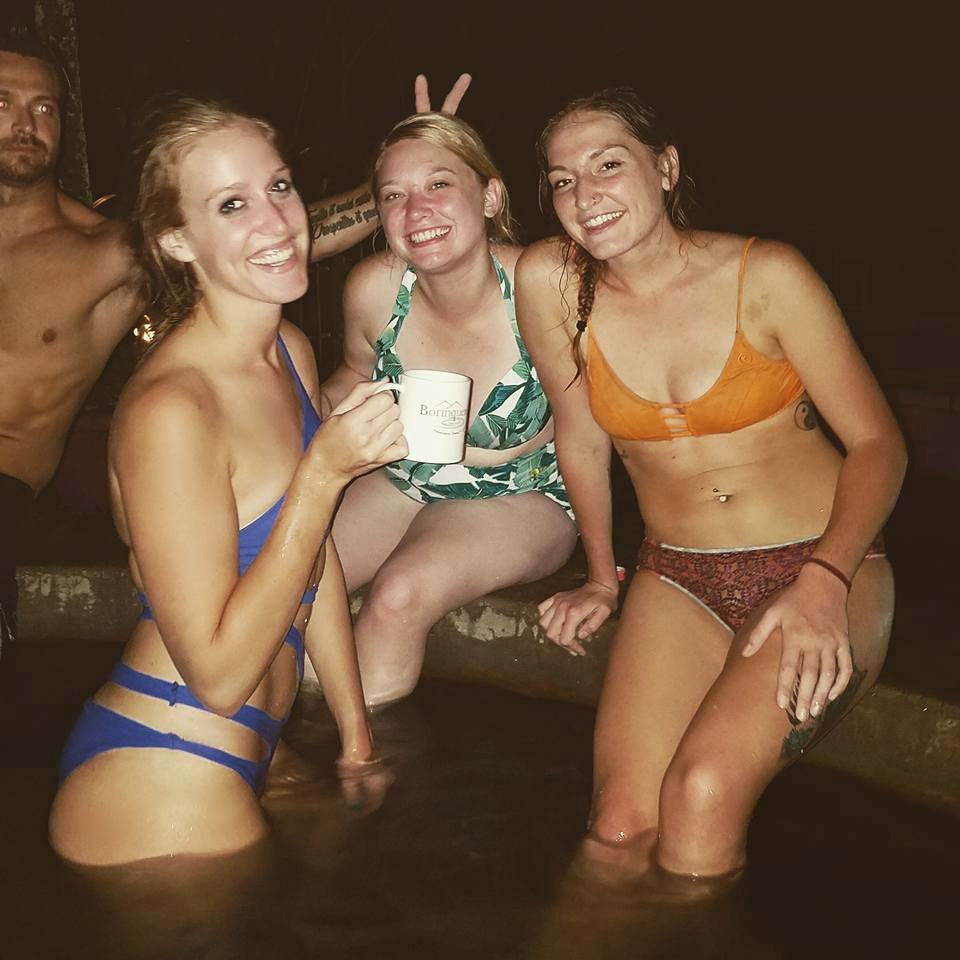


Later that night we all went back to one room to play games and order in room service. It was then I discovered that I truly do know Spanish if I put my mind to it. I've always been convinced that my five years of Spanish has nothing to show for it, but when I'm forced to put it to the test, I can pull through. I had to order room service for about 6 of us and the man didn't speak a lick of English...and it was extremely important that we got our late night food. So I came through for us all with my Spanish words for needed greasy American food.
DAY 4:
We set off early morning again to make our way to the Nicaraguan border. On our drive toward the border, we passed a refugee camp. Here, hundreds of Africans were set up in tents. They had been refugees from their own country and originally landed in Ecuador. They were then in pursuit to make their way up to America, but had been stopped in Costa Rica and are now currently living there in these tents. Once we got to the Costa Rica/Nicaragua border briefly after the refugee camp, we discovered the borders were very tight. There were five check points within 15 miles of the border where our bus was stopped and Nicaraguan military personnel got on to check all of our passports. We also discovered a very long line of trucks backed up trying to make it through customs and we were told that a truck trying to pass from one country to another would have to wait roughly three days to get through.
In Nicaragua, we had to change tempo a little bit from what we got accustomed to in Costa Rica. Here, about one American dollar was equal to 30 cordobas (the word for Nicaraguan currency). Also, the Nicaraguan people were poorer than the Costa Ricans, and we were often approached by individuals and young children begging for money (which we are used to on several of our other travels). We started our Nicaraguan experience off by visiting Laguna de Apoyo (Apoyo Lagoon) which is a huge lake that used to be a volcano. However, 23,000 years ago, the volcano erupted in an event that caused the entire structure to collapse and form a lagoon that filled with water over time. It is still surrounded by the old crater wall. It is considered a great spot for swimming and relaxing, however, there is still an active fumarole at the western shore of the lagoon, so the volcano is not yet dormant.

Laguna de Apoyo (Apoyo Lagoon)
After overlooking this beautiful view, we had some time to browse the area's shops. We talked to some of the locals, mentioning where we were from. When I asked one man if he knew where Wisconsin was, he said he had heard of it as there's been many people from Wisconsin, Chicago, Florida, California, etc. that come to visit their country. I asked if he had ever been anywhere in the U.S. and he immediately said "Noooo. No. I don't think I want to go." When I asked why he declared that our country is dangerous and full of lots of terrorism, and that in their country they never have to worry about going "boom." He admitted that he thinks America is a beautiful country but he would be too worried to ever visit. We kind of laughed and said that's not how it always is everywhere, but it was interesting to see that this is some other countrys' perception of life in America.
Next we headed to see the Masaya volcano. This is an active volcano that last erupted in 2008 and is Nicaragua's first and largest national park, being one of 78 protected areas in the country. The volcano's eruptions have had a dramatic impact on its surroundings, and volcanic ashes still fill the area daily. Because of this, visitors are only allowed to be at the top of the volcano for five minutes at a time due to the heavy expenditure of fumes. There are guards at the top to ensure that the public abides by these rules and only comes for a short visit. The coolest thing about this volcano was our ability to look down the crater to see actual lava flowing through the volcano. Like legit real life lava! I've never in a million years thought I would have the opportunity to see lava in person with my own eyes, and not melt to tell about it!

Next we made our way to Lake Nicaragua, which is easily the largest lake in the country (look at any general map of Nicaragua and you can't miss it). Here we got on tour boats that took us out to explore the channels of Las Isletas (Little Islands), which is an archipelago conformed of 365 small islands made of volcanic material. These islands have been utilized over the years to build expensive homes and vacation condos. We were taken to one of the islands, dubbed "Monkey Island", that was a small piece of land inhabited by about five or six spider monkeys. They were very intrigued by our presence! On our way back toward land, we had the pleasure of witnessing one of the most beautiful sunsets I've ever seen. The skies were cotton candy pink and blue and we had an excellent view of the silhouetted volcanoes on the shoreline. They aren't lying when people tell you Costa Rica and Nicaragua have some of the best sunsets ever!


To conclude our evening, we ventured into the city of Granada where we checked into the Hotel Colonial for the night. This was a very quaint hotel in the heart of the city. We changed and met our group for dinner at a local restaurant where we sat at a large table outside and listened to a couple local Mariachi-type bands feud back and forth for the customers' attention. After dinner, our tour's photographer took some of us out to a local bar where we danced for several hours. They played a lot of American music that we recognized and learned that this was actually the type of music most people listened to in these countries.

The Hotel Colonial in Granada, Nicaragua.
DAY 5:
We rose for our last early morning of the trip and had breakfast at our hotel while preparing to explore the city before heading to one of Nicaragua's most popular beaches. We ventured through Granada for part of the morning, exploring old cathedrals and churches while admiring the history of the quaint colonial city. We were also taken to a local cigar shop where we were able to watch cigars in the process of being made.


After, we headed to San Juan del Sur where we ventured up to a cliff overlook. The hike up the cliff was steep and full of cobblestone, but the view from the top was every bit worth it (except for maybe Rachele because she was super hungover). Here we learned about a statue placed there called Cristo de la Misericordia, or Christ of the Mercy. This statue is tied in to the other famous Jesus statues around the world, like Christ the Redeemer in Rio de Janeiro, Brazil. Christ of Mercy was paid for by a man who had terminal cancer and was given two months to live, but was suddenly cured completely. He found the act to be a miracle of God and wanted this statue built as a way to show his gratitude.


Under the statue was a small chapel that depicted informational displays of other Christ statues around the world and the processes used to build the Christ of Mercy statue.

After enjoying the views overlooking the beaches of San Jan del Sur, we ventured down to a beach front restaurant where we enjoyed cheap drinks and excellent food. Our table got carried away with the "beverage" portion of lunch and every time our waiter came and asked us for our order we mistook his question by requesting more drinks. It wasn't until about an hour later that we started questioning when they were going to take our food order, only to discover everyone else in our tour had ordered food forever ago. Most of us indulged in a plate of lobster that was only about $10 (American) total. Afterwards I walked the beach briefly and discovered at least three dead puffer fish washed up on shore. As messed up as it was, I was so thrilled to see a real life puffer fish, even if they were dead.


After a relaxing afternoon, we all boarded the bus once more to head back toward Costa Rica. Customs was another lengthy process, but it was easier to get into Costa Rica than it was Nicaragua. We headed to Samara where our resort for the next three nights was located on one of Central America's most appraised beaches. We got in late but enjoyed one last group dinner together with our tour guides as this was our last night with them. I'll just take a moment to say that we sincerely had some of the best guides I could have asked for on this trip. They were so knowledgeable about the two countries and taught us more than I could have expected. They were also really fun to have along on all of our adventures!! So a huge shoutout and thank you to Fabian, Aaron and Francisco for being truly amazing and making our trip just that much better.
Day 6, 7 and 8:
The last few days of our trip were designated to fun and relaxation. No more waking up by 6AM and partaking on bus rides across the country (not that I minded any of that whatsoever). Our all-inclusive resort was located near the small, remote tourist town of Samara, that had several little shops for us to explore. Since Halloween fell on the weekend we were there, several of us brought costumes to Costa Rica to dress up on Saturday night. I honestly did not expect anyone else to be dressed or partaking in Halloween festivities, but there were several bars on the beach near our resort that were decorated for the holiday and dozens of people dressed up as well.

Rocky shore on our hike off our resort's beach in Samara, Costa Rica.

La Playa Samara
The rest of our days were spent at the wet bar, hiking along the beach, shopping and eating seven meals at a time (that's what all-inclusive is all about...right?). It was a great way to finish up an event-packed week. We also learned that in Costa Rica, they have a drink called the "Wisconsin." Obviously, I had to try this. When I requested it from the bartender, he gave me a sly look like, "are you sure?" Next thing you know, he sets down a cup of pure whiskey on the rocks in front of me. Yup, sounds about right.


On the last day, we all got on a bus one last time that drove us back to Liberia in preparation for our flights home. Usually by the end of most vacations, I reflect on how great they were but can acknowledge that it's time to go home. This is not how I felt at the end of this trip, however. I genuinely did not want it to end as I enjoyed my time in these two countries far more than I could have anticipated. They are truly beautiful and we met amazing people along the way. I can sincerely say that Costa Ricans are some of the nicest people I have ever met. They are authentically happy people and treated us as if we were family, whether they were our tour guides, our waiters or a cashier at a souvenir shop. They whole-heartedly live by their popular phrase, Pura Vida, which means "pure life." It's not just a saying, but a way of living to them, and they embody the values of peace and happiness with every ounce of their being.
I highly recommend to ANYONE contemplating a travel destination to consider Costa Rica in the mix, as it will provide you with experiences like no other. This country will forever hold a very special place in my heart.


Laguna de Apoyo (Apoyo Lagoon), Granada and the channels of Las Isletas (Little Islands) from the sky.

Comments